

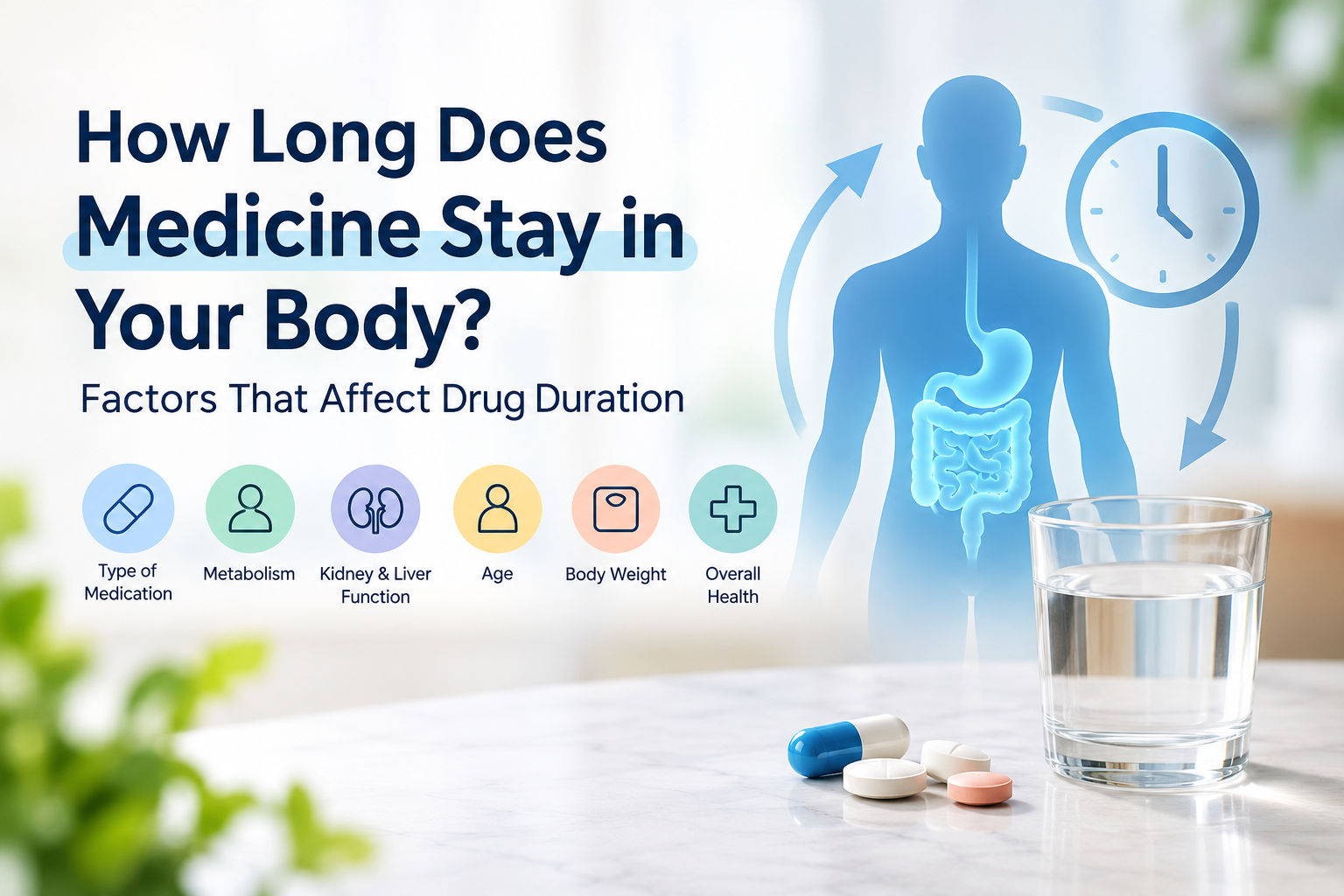
How Long Does Medicine Stay in Your Body? Factors That Affect Drug Duration
How Long Does Medicine Stay in Your Body? Factors That Affect Drug Duration
Have you ever wondered how long a medicine remains in your body after you take a dose? The answer is not the same for every medicine or every person. Some medicines are removed from the body within hours, while others can remain in the body for several days or longer.
Understanding how long a medicine stays in your system can help explain why some medicines are taken once a day while others need to be taken several times throughout the day.
What Does “Stay in Your Body” Mean?
When people ask how long a medicine stays in the body, they are usually asking how long the drug or its active substances remain at detectable or pharmacologically relevant levels.
After you take a medicine, your body generally goes through several processes:
- Absorption – The medicine enters the bloodstream.
- Distribution – It travels through the blood to different tissues and organs.
- Metabolism – The body chemically changes the medicine, often through enzymes in the liver.
- Elimination – The medicine and its metabolites are removed from the body, primarily through the kidneys and urine, but also through stool, breath, or other routes.
The amount of time each process takes varies from one medicine to another.
What Is a Drug’s Half-Life?
One of the most important terms used to describe how long a medicine remains in the body is half-life.
A drug’s half-life is the approximate amount of time required for the concentration of the medicine in the body to decrease by half.
For example, if a medicine has a half-life of 8 hours:
- After 8 hours, approximately 50% remains.
- After 16 hours, approximately 25% remains.
- After 24 hours, approximately 12.5% remains.
- After 32 hours, approximately 6.25% remains.
This is a simplified example, but it demonstrates why a medicine does not necessarily disappear immediately after its effects begin to wear off.
How Long Does Medicine Usually Stay in the Body?
There is no universal answer.
The duration can range from a few hours to several days or longer depending on the medicine.
Some medicines have short half-lives and are eliminated relatively quickly. Others have longer half-lives and can accumulate in the body when taken regularly.
Importantly, the time a medicine produces noticeable effects is not necessarily the same as the time the medicine remains in the body.
A medicine may stop producing noticeable effects while small amounts are still present in the body.
Factors That Affect How Long Medicine Stays in Your Body
1. The Type of Medicine
Every medicine has its own chemical properties, metabolism, and elimination characteristics.
For example, some medicines are designed to work for only a few hours, while extended-release formulations are designed to release their active ingredient gradually over a longer period.
2. Liver Function
The liver plays an important role in metabolizing many medicines.
If liver function is impaired, certain medicines may be processed more slowly. This can cause the medicine to remain in the body longer and may increase the risk of side effects.
People with liver conditions may therefore require different doses or dosing schedules for certain medicines.
3. Kidney Function
The kidneys help remove many medicines and their metabolites from the body through urine.
Reduced kidney function can slow the elimination of certain drugs. Depending on the medicine, a healthcare professional may need to adjust the dose or dosing interval.
4. Age
Age can affect how the body absorbs, processes, and eliminates medicines.
Older adults may process some medicines more slowly because kidney and liver function can change with age. Children can also process medicines differently from adults.
This is one reason medication doses are often based on age, weight, medical condition, or other factors.
5. Body Size and Composition
Body weight and body composition can influence how some medicines are distributed throughout the body.
Some drugs are more likely to accumulate in fatty tissue, while others primarily remain in body water or blood.
Therefore, two people taking the same medicine may not necessarily process it in exactly the same way.
6. Other Medicines
Taking multiple medicines can affect how quickly a particular drug is metabolized or eliminated.
Some medicines can increase or decrease the activity of liver enzymes responsible for drug metabolism. This can potentially change how long another medicine remains in the body.
Always tell your healthcare professional about all prescription medicines, over-the-counter medicines, and supplements you use.
7. Food and Alcohol
Food can affect the absorption of some medicines. Certain foods or beverages can also interact with specific medications.
Alcohol can affect the body’s handling of some medicines and may increase certain side effects, particularly drowsiness or impaired coordination with medicines that already have sedating effects.
Whether food or alcohol matters depends on the specific medicine.
8. Genetics
Genetic differences can influence how quickly a person’s body metabolizes certain medicines.
Some people naturally break down particular medicines faster or slower than others because of differences in drug-metabolizing enzymes.
9. How Often the Medicine Is Taken
When a medicine is taken repeatedly, each new dose may be added before the previous dose has been completely eliminated.
This can cause the medicine to build up in the body until a relatively stable concentration, known as steady state, is reached.
The time needed to reach steady state depends largely on the medicine’s half-life.
10. The Form of the Medicine
The formulation can affect how quickly a medicine is released.
For example:
- Immediate-release tablets may release medicine relatively quickly.
- Extended-release formulations are designed to release medicine more gradually.
- Injections can have very different absorption and elimination patterns compared with oral tablets.
Always take extended-release or modified-release medicines exactly as directed.
Does Feeling Better Mean the Medicine Is Completely Gone?
Not necessarily.
The therapeutic effect of a medicine may disappear before the medicine has been completely eliminated from the body.
For example, a person may no longer feel the noticeable effects of a medicine while measurable amounts of the drug or its metabolites remain in the body.
This distinction is particularly important when considering driving, operating machinery, alcohol consumption, drug testing, or taking another medicine.
How Long Does It Take for a Medicine to Leave the Body Completely?
In pharmacology, a commonly used approximation is that it takes around 4 to 5 half-lives for most of a medicine to be eliminated from the body.
For example, if a medicine has a half-life of 10 hours:
- After 10 hours: about 50% remains.
- After 20 hours: about 25% remains.
- After 30 hours: about 12.5% remains.
- After 40 hours: about 6.25% remains.
- After 50 hours: about 3.1% remains.
This is an approximation rather than an exact rule. Some medicines have active metabolites that remain longer than the original drug, and elimination can vary between individuals.
Can You Make Medicine Leave Your Body Faster?
Generally, you should not try to speed up drug elimination on your own.
Drinking excessive amounts of water, exercising intensely, skipping meals, or using other substances does not reliably “flush” a medicine from the body and may sometimes be harmful.
If you accidentally take too much medicine or experience concerning symptoms after taking a medication, contact a healthcare professional or an appropriate poison-control/emergency service rather than attempting to remove the medicine yourself.
Does Drug Testing Detect How Long a Medicine Stays in the Body?
Drug detection is different from drug elimination.
A test may detect a medicine or its metabolites after the medicine is no longer producing noticeable effects.
Detection time depends on several factors, including:
- The specific drug
- The dose
- How frequently it was taken
- The type of test
- Individual metabolism
- The sensitivity of the test
- The presence of active metabolites
Therefore, there is no single detection window that applies to every medicine or every person.
Frequently Asked Questions
How long does medicine stay in your system?
It depends on the medicine, its half-life, the dose, how frequently it is taken, and individual factors such as kidney and liver function. Some medicines leave the body relatively quickly, while others can remain for days or longer.
What is the fastest way to get medicine out of your system?
There is no universal or reliably safe method for rapidly removing a medicine from the body. The body normally eliminates medicines through natural metabolic and excretory processes.
Does drinking water remove medicine from your body?
Water supports normal hydration and kidney function, but drinking excessive amounts of water does not generally cause medicines to leave the body significantly faster.
Does food affect how long medicine stays in your body?
Food can affect the absorption of some medicines, but the effect varies depending on the drug. Some medicines are recommended with food, while others may need to be taken on an empty stomach.
Do older adults keep medicine in their bodies longer?
Some medicines may remain in the bodies of older adults for longer, particularly when kidney or liver function has declined. However, this varies depending on the medicine and the individual.
Can two people eliminate the same medicine at different speeds?
Yes. Differences in age, genetics, body composition, kidney and liver function, other medicines, and overall health can affect drug metabolism and elimination.
Final Thoughts
There is no single answer to the question, “How long does medicine stay in your body?” Each medicine has its own pharmacokinetic properties, and individual factors can significantly influence how quickly it is processed and eliminated.
The drug’s half-life is one of the most useful measurements for understanding its duration in the body. However, half-life does not necessarily tell you exactly how long you will feel the effects of a medicine or how long a drug may remain detectable on a test.
If you have questions about how long a specific medicine may remain in your body, speak with your doctor or pharmacist. Do not change your dosage, stop a prescribed medicine, or combine medicines without appropriate medical advice.
Medical Disclaimer: This article is intended for general educational purposes only and should not be considered medical advice, diagnosis, or a substitute for consultation with a qualified healthcare professional.